
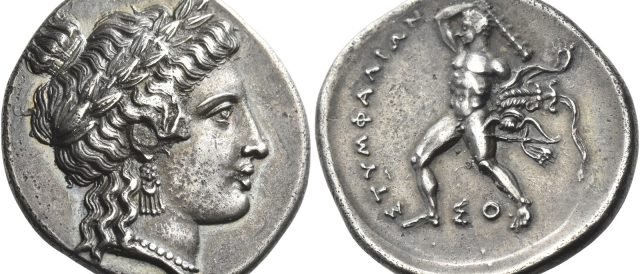
Stymphalos Silver Stater (c. 350 BC) — a collector’s story of myth, mountains, and quiet power
Some Greek coins shout.
Others whisper — and draw you closer.
The silver stater of Stymphalos, struck around 350 BC, belongs firmly to the second kind. It is not famous in the way Athens or Syracuse is famous. It does not overwhelm with size or flamboyance. Instead, it rewards the collector who listens — to myth, to landscape, and to a small Arcadian city that knew exactly who it was.
This is a coin you don’t encounter early in your collecting life. You arrive at it later, when spectacle has begun to lose its hold and meaning matters more than name recognition.
Discovering Stymphalos: a coin that feels “out of the way”
Most collectors first meet Stymphalos not through coin trays, but through myth.
The Stymphalian Birds, one of the Twelve Labors of Herakles, haunt the memory long before the city itself becomes real. A remote lake in the mountains of Arcadia. Dangerous bronze-feathered birds. A hero sent far from civilization to deal with something wild and unsettling.
When you finally see a Stymphalos stater, that atmosphere comes with it.
The flan is compact. The silver has a slightly heavier, grounded feel typical of Arcadian staters. Nothing flashy. Nothing excessive. And yet, the iconography is unmistakably intentional.
This is a city placing its mythic identity on its coinage — not for outsiders, but for itself.
The obverse: Herakles, not as hero — but as presence
On most examples, the obverse shows Herakles, often in profile, youthful but powerful, wearing the lion skin or rendered with unmistakable heroic calm. This is not the raging, action-filled Herakles of later art. This is a composed figure — controlled strength rather than violence.
For a collector, that matters.
The engraving is confident but restrained. The facial features are solid, not idealized into abstraction. You sense a local engraver working with pride rather than spectacle. This is Arcadian Herakles — the hero who walked these mountains, not a pan-Hellenic celebrity.
In hand, the portrait feels intimate. Almost personal.
The reverse: the Stymphalian Bird — and why it matters
Turn the coin, and the city speaks clearly.
The Stymphalian bird, often shown standing or poised with wings partially open, is not decorative. It is a declaration. This is the creature that defined the city’s mythic landscape — a symbol of danger, endurance, and survival in a harsh environment.
Unlike the elegant owls of Athens or the racing quadrigas of Sicily, this bird feels rooted. It belongs to marshland, reeds, and isolation. It reflects a city that didn’t pretend to be coastal, wealthy, or imperial.
Collectors who understand Greek coins recognize this immediately: local identity preserved in silver.
The ethnic inscription — usually ΣΤΥΜΦΑΛΙΩΝ or abbreviated forms — anchors the image. No explanation needed. This coin was never meant to travel far. It was meant to circulate among people who already knew the story.
The Arcadian character in metal
Arcadian coinage has a reputation among experienced collectors.
It tends to be:
-
Solid rather than flamboyant
-
Conservative in weight and style
-
Deeply mythological, but not theatrical
The Stymphalos stater fits perfectly into that tradition.
At around 350 BC, Arcadia was navigating a complicated political landscape — regional leagues, shifting alliances, pressure from larger powers. Cities like Stymphalos expressed stability not through innovation, but through continuity.
This coin reflects that mindset. It is not trying to impress Athens. It is not competing with Corinth. It is asserting presence: we are here, we endure, and our story matters.
Holding the coin: what collectors feel but rarely write
There is a physical honesty to this stater.
The relief is moderate. The surfaces often show light irregularities — not flaws, but evidence of real circulation. The silver tone tends toward soft gray, sometimes with cabinet toning that enhances the bird’s silhouette.
You don’t flip this coin nervously. You don’t rush to check auction comparisons. You simply hold it, and it feels… settled.
Many collectors describe Arcadian coins as “quietly confident.” The Stymphalos stater embodies that better than most.
Rarity and the collector’s advantage
Here’s the part experienced collectors appreciate most:
Stymphalos staters are scarce — but not unobtainable.
They appear occasionally in serious auctions. They are respected, but not yet chased by trend-driven buyers. That creates a rare opportunity: a coin with strong mythological grounding, solid artistry, and genuine regional character — without the crushing price pressure of headline types.
For collectors who have moved beyond “greatest hits” Greek coinage, this stater feels like a discovery rather than a trophy.
And discoveries are often more satisfying.
What it represents in a collection
In a tray of Greek silver, the Stymphalos stater does something subtle.
It slows the viewer down.
Collectors lean in. They ask questions. They recognize the bird — or they don’t, and want to learn. The coin becomes a conversation piece, not because it dominates visually, but because it carries story.
It pairs beautifully with:
-
Other Arcadian issues
-
Coins of Herakles across regions
-
Myth-themed Greek collections
And it reminds every serious collector of an essential truth: Greek coinage is not just about power centers — it is about places.
Final collector reflection
The Stymphalos silver stater is not a coin of empire.
It is a coin of landscape, memory, and identity.
It comes from a lake surrounded by mountains. From a myth that speaks of fear overcome, not conquest celebrated. From a city that chose to define itself honestly rather than grandly.
For collectors who value meaning over noise, this coin becomes more than a type. It becomes a reminder of why Greek coins endure — not because they are all famous, but because they are all human.
And sometimes, the quiet ones stay with you longest.