
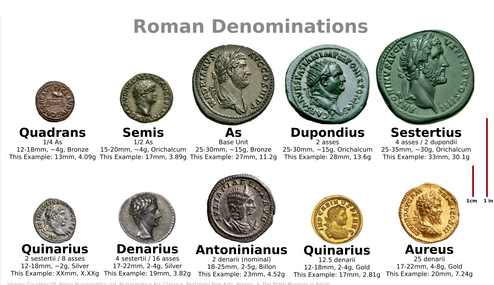
Roman Coin Materials and Metals: From Bronze to Gold
Long before paper money, Rome measured its worth in metal. Every coin — whether bronze, silver, or gold — was a reflection of power, economy, and faith in the state.
When you hold a Roman coin today, you’re not just holding currency; you’re holding the empire’s economic heartbeat.
Each metal had its purpose: bronze for the people, silver for the soldiers, and gold for the gods and emperors.
💬 In Rome, money wasn’t just minted — it was ideology made tangible.
🪙 The Roman Monetary Hierarchy
At the height of the empire, Rome maintained a metal-based monetary system, where each denomination corresponded to a specific metal and weight.
| Metal | Denomination | Typical Weight | Role in Economy |
|---|---|---|---|
| Gold (Aureus / Solidus) | High-value imperial coin | 7–8 g (Aureus), 4.5 g (Solidus) | Elite payments, tributes, and savings |
| Silver (Denarius / Antoninianus) | Standard silver currency | 3.5–4 g | Daily army and trade payments |
| Bronze (As / Sestertius) | Common base metal coin | 10–25 g | Market and civic circulation |
| Copper / Brass (Dupondius, Quadrans) | Small-value coins | 3–13 g | Everyday use for food and goods |
| Billon (Low-silver alloy) | Late debased issues | — | Transition during crisis periods |
💬 Gold for the emperor, silver for soldiers, bronze for the baker.
⚖️ Gold: The Aureus and the Solidus
The Aureus (c. 211 BC – 4th century AD)
-
Pure gold (~99%)
-
Struck at 1/40 of a Roman pound (~8 grams)
-
Served as Rome’s prestige coin — often used in imperial gifts, army bonuses, and diplomacy.
Example:
AVGVSTVS DIVI F – An aureus of Augustus, a golden proclamation of divine lineage.
The Solidus (Introduced by Constantine I, c. AD 312)
-
Replaced the aureus at a lighter weight (1/72 of a pound, ~4.5 g).
-
Maintained stability for 700+ years, becoming the standard coin of Byzantine and medieval Europe.
💬 The solidus outlived the empire that created it.
💎 Silver: The Denarius and Its Decline
The Denarius (Introduced 211 BC)
-
The backbone of Rome’s silver economy for over 400 years.
-
Originally nearly 98% pure silver, gradually debased to under 40% by the 3rd century AD.
Example:
IMP NERO CAESAR AVG – Silver denarius of Nero, minted before major debasement.
The Antoninianus (c. AD 215)
-
Introduced by Caracalla, nominally worth two denarii, but contained only 1.5x the silver.
-
Sparked inflation and public distrust — early lessons in failed monetary policy.
💬 The denarius began as Rome’s pride — and ended as its economic warning.
🟤 Bronze and Copper: Coins of the People
The As (plural: asses)
-
The foundation coin of the early Republic.
-
Initially cast in heavy bronze, later struck as lighter discs.
The Sestertius
-
Large bronze coin (~25–30 mm) used for commerce and imperial imagery.
-
Portraits were detailed, making them favorites among modern collectors.
Example:
NERO CLAVD CAESAR AVG GERM P M TR P IMP P P – Nero’s sestertius, showing a temple or triumphal arch.
The Dupondius & Quadrans
-
Everyday trade coins.
-
Dupondius made of orichalcum (brass alloy); Quadrans in low-value copper.
-
Carried local symbols — ships, deities, and animals.
💬 Bronze coins were Rome’s true social media — circulating images of power to the masses.
⚗️ Alloy Experiments and Debasement
By the 3rd century AD, economic crises forced emperors to stretch precious metal supplies.
Techniques of Debasement
-
Mixing silver with copper (billon coins).
-
Silver “washing” — thin plating to mimic high purity.
-
Reducing coin weight while keeping face value.
Result:
Inflation, distrust, and hoarding of older coins.
💬 When the silver vanished from Rome’s coins, so did public confidence.
🧱 Composition Table by Era
| Period | Primary Metals | Example Coin | Notes |
|---|---|---|---|
| Republican (300–27 BC) | Bronze, silver | Denarius of Julius Caesar | Heavy bronze asses, pure denarii |
| Early Empire (27 BC – AD 200) | Gold, silver, bronze | Aureus of Augustus | Tri-metal system stabilized |
| Crisis Period (AD 235–284) | Debased silver, billon | Antoninianus of Gallienus | Rampant debasement |
| Late Empire (AD 284–476) | Gold, bronze | Solidus of Constantine | Gold stable; bronze common |
| Byzantine Transition (5th–6th c.) | Gold, copper | Solidus of Justinian | Copper follis reintroduced |
🧩 How to Identify Roman Coin Metals
| Test | What to Check | Why It Helps |
|---|---|---|
| Color | Bright yellow = gold, gray-white = silver, brown = bronze | Quick visual clue |
| Weight | Use precision scale | Matches metal and denomination |
| Sound Test | Ping resonance (long ring = silver) | Traditional but risky |
| Magnet Test | Real ancient metals = non-magnetic | Quick counterfeit check |
| Surface Texture | Porous = bronze corrosion; smooth shine = silvered | Identifies cleaning or plating |
🧠 A trained eye reads metal the way a scholar reads Latin.
💰 The Symbolism of Metals
Each metal had deep symbolic meaning in Roman society:
| Metal | Symbolism | Used By |
|---|---|---|
| Gold (Aureus) | Immortality, divine favor | Emperors, generals, nobility |
| Silver (Denarius) | Duty, military strength | Soldiers, merchants |
| Bronze (Sestertius) | Stability, commonwealth | Citizens, markets |
| Copper (Quadrans) | Labor, humility | Everyday transactions |
💬 Gold proclaimed glory, silver paid for it, and bronze preserved it.
⚒️ Economic Lessons from Metal
Rome’s economic trajectory can be traced by its metal content:
-
Pure metals = confidence and control
-
Debasement = crisis and corruption
-
Reform = recovery and adaptation
By tracking purity, historians reconstruct inflation rates, trade routes, and even wars.
📈 A nation’s soul can be weighed — sometimes in grams of silver.
🔗 Internal NumisDon Connections
-
Roman Coin Inscriptions and Abbreviations
-
Roman Mint Marks: Decoding the Hidden Geography of Empire
-
Roman Coin Values: Collector’s Guide by Metal Type
-
How to Identify Counterfeit Roman Coins
💬 FAQs – Roman Coin Metals
Q1. What were Roman coins made of?
Gold, silver, bronze, brass (orichalcum), and copper alloys.
Q2. Did Rome use iron coins?
Very rarely — iron corroded easily and lacked prestige.
Q3. Why did the denarius lose its value?
Government debasement — mixing cheaper metals to produce more coins.
Q4. Which Roman coin was most valuable?
The Aureus, later replaced by the Solidus.
Q5. Are bronze coins collectible?
Absolutely — especially well-preserved sestertii with clear portraits.
🏺 Conclusion – Rome’s Wealth in Metal and Meaning
Every Roman coin, from bronze to gold, was more than currency — it was a mirror of empire.
Its metal revealed the strength of Rome’s treasury, the ambitions of its emperors, and the faith of its people.
To study the metals of Roman coinage is to watch a civilization rise, peak, and endure — in alloys that still gleam after two millennia.
💬 Gold was Rome’s pride, silver its pulse, and bronze its promise to the people.
Author: Dr. Elena Voss – Historian of Roman Economy and Numismatic Metals