
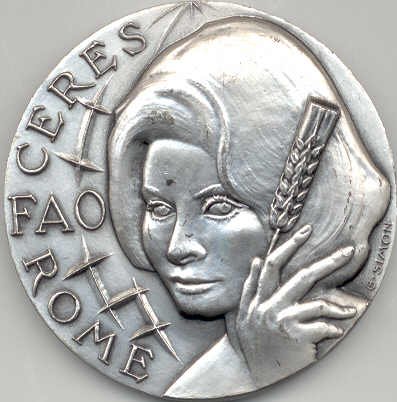
CERES FAO ROME COIN – A COLLECTOR’S GUIDE
If you search for the “Ceres FAO Rome coin”, you’re probably curious about one of the lightest, simplest, and yet surprisingly meaningful tokens ever produced by the Rome Mint.
So let me give you the answer straight away:
The Ceres FAO Rome coin is an aluminum token struck in Rome in the early 1970s for the FAO “Food for All” campaign. It features the Roman goddess Ceres on one side and the FAO emblem or wheat-themed designs on the other. Most pieces are lightweight, educational medals—not legal tender—and today they’re collected for their symbolism and history more than their monetary value.
That’s the quick explanation.
Now let’s dive in properly — collector to collector — and look at what this little medal actually represents, how many versions there are, how much it’s worth, and why so many people are suddenly searching for it again.
—
Why This Coin Exists (The Simple Version)
If you hold one of these tokens in your hand, you might think it’s “just aluminum.”
But behind it is a big idea.
Back in the late 1960s, the FAO (Food and Agriculture Organization of the UN) was trying to raise global awareness about hunger, nutrition, and agriculture. Instead of only using posters and leaflets, they chose something more symbolic:
Coins and medals that people could keep, trade, and talk about.
The Rome Mint produced a whole series of FAO medals during that time, and the Ceres edition quickly became one of the most recognizable because:
Ceres = goddess of agriculture
FAO = mission to feed the world
Rome = birthplace of FAO headquarters
The message was simple:
“Food is a basic human right.”
These medals were handed out during FAO conferences, Human Rights Day events, and educational programs. Many people still remember receiving them as children during school visits in the 1970s.
—
What the Ceres FAO Rome Coin Looks Like (in Plain Words)
Obverse (Front)
A clean portrait of Ceres, with grain spikes in her hair
“CERES FAO ROME” or variations of the slogan
Often signed by Italian engravers (Mistruzzi, Piccirilli, etc.)
Reverse (Back)
Depending on the edition, you might see:
the FAO emblem
wheat sheaves
human figures (mother and child)
slogans like “TOWARD FOOD FOR ALL” or “Right to Food”
Metal: mostly aluminum, a few bronze versions
Weight: around 1–2 grams (aluminum), 3–4 grams (bronze)
Diameter: 22–28 mm
Edge: plain
These were not coins for spending — they were messages in metal.
—
Quick Specs Table (2025 Version)
Feature Details
Issuer FAO (Rome, Italy)
Mint Istituto Poligrafico e Zecca dello Stato
Theme Ceres – Roman Goddess of Agriculture
Years Issued approx. 1969–1975
Composition Aluminum (common), Bronze (rare)
Diameter 22–28 mm
Weight 1–3 g
Purpose Educational / commemorative token
Motto “Food for All”
—
A Bit of Real History (Not Textbook Style)
The FAO medal program started around 1968, when global hunger was still widespread after WWII. The idea was to use coins to remind governments and schools of their responsibility to provide access to food.
The Ceres FAO Rome medal became one of the highlights of this movement because it blended:
ancient mythology
modern humanitarian ideals
Italian artistic engraving
These medals were given out during:
FAO conferences
international exhibitions
humanitarian campaigns
school events
Rome Mint public visits
Some versions were made specifically for Human Rights Day 1973, marking the 25th anniversary of the Universal Declaration of Human Rights.
—
Known Variants (Most Collectors Don’t Realize There Are Several)
Here are the most talked-about versions today:
⭐ 1. 1970 Olave Baden-Powell Edition
Shows the World Chief Guide on the obverse.
Celebrates women’s contributions to nutrition programs.
⭐ 2. 1973 Human Rights Day Medal
Mother and child design, surrounded by wheat ears.
Strong symbolic value, popular with UN collectors.
⭐ 3. Ceres Classical Head (Type I & II)
The most searched version.
Ceres facing right with grain crown.
Very lightweight aluminum.
⭐ 4. Princess Irene of Bourbon-Parma Issue
Theme: children, nutrition, global education.
Some pieces only given to delegates and ambassadors.
⭐ 5. Bronze Proof Presentation Pieces
Ultra-low mintage (<2,000 known).
Mirror surfaces, deeper relief.
These are the only versions that consistently rise in value.
Most people searching for “Ceres FAO Rome coin” are looking for the classical aluminum Ceres version — the cheapest but most iconic.
—
How Much Is the Ceres FAO Rome Coin Worth in 2025?
Let’s keep this honest and simple.
These medals were made in large quantities, especially the aluminum ones. So their financial value is low, but collector interest is strong.
Here are real 2025 market prices based on eBay + auctions:
Condition Value (USD)
VF $0.50 – $2
XF $3 – $7
Uncirculated $10 – $20
Bronze variant $25 – $50+
Only the bronze proof pieces break the $40+ range.
So is it rare?
👉 Common.
But meaningful — and collectible.
—
How to Tell if Your Ceres FAO Rome Coin Is Authentic
Here’s what I usually check:
✅ 1. Weight
Aluminum: around 1.8–2.2 g
Bronze: around 3 g+
Fake ones often weigh too much.
✅ 2. Sharpness of the FAO emblem
The little lines inside the emblem should be crisp.
Cheap fakes often have soft edges.
✅ 3. Ceres’s facial details
Genuine medals show a clear nose, lips, and grain crown texture.
✅ 4. No seam on the edge
If you see a horizontal seam → likely cast → likely fake.
Luckily, most fakes are obvious.
—
Why Collectors Love These Medals (And Why Searches Are Rising)
Three reasons:
⭐ 1. They symbolize something bigger than money
This is a piece of the global “Food for All” campaign — a message that still matters today.
⭐ 2. Cheap entry point
New collectors love affordable pieces with real history.
⭐ 3. The design connects ancient Rome with modern ideals
Ceres represents agriculture and nourishment.
FAO represents global cooperation.
Beautiful combination.
—
Collector Tips (From Experience)
- Don’t polish aluminum — it scratches instantly.
- Store in a capsule; humidity ruins aluminum.
- Keep any original FAO paperwork — it doubles the value.
- The bronze versions are the only true investments.
- If listing one online, always include weight and diameter.
—
Frequently Asked Questions
❓ Is the Ceres FAO Rome coin legal tender?
No — it’s a commemorative token.
❓ Why is Ceres on it?
She’s the Roman goddess of agriculture, symbolizing food security.
❓ How many were made?
Estimates range from 50,000 to 100,000+ aluminum pieces.
❓ Are there rare versions?
Yes — bronze proof editions and presentation medals.
❓ Why is this coin trending in 2025?
Because FAO themes connect strongly with sustainability and UN SDG goals.
—
Conclusion
The Ceres FAO Rome coin may not be worth a fortune, but it remains one of the most meaningful medals of the FAO campaign — a small reminder of a worldwide promise:
“Food for All.”
If you’ve collected one, you’re holding a symbol of history, humanity, and hope.