
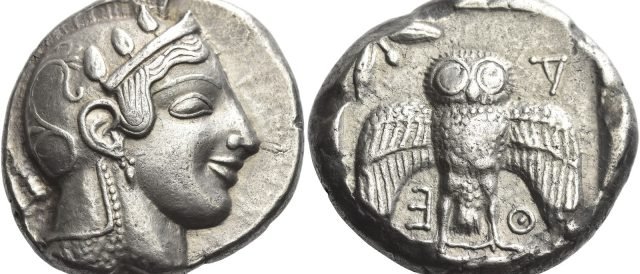
Attica, Athens. Decadrachm (c. 467–465 BC)
A collector’s story of the coin you don’t chase — you wait for
There are ancient coins you acquire because they fit neatly into a series. You tick a box, update a tray, move on. And then there are coins that sit quietly in the background of your collecting life, never fully out of mind, never fully within reach.
The Athenian decadrachm is one of those.
For most of us, the relationship begins innocently enough. We start with an owl tetradrachm — solid, iconic, reassuring. Athena in profile. Owl standing to the side. A coin that feels like the handshake of Greek numismatics. But somewhere along the way, usually late at night scrolling through old auction catalogues or standing silently in front of a museum case, you see it.
And from that moment, your idea of Athens changes.
First contact: when scale changes meaning
Photographs do not prepare you for a decadrachm. Even experienced collectors underestimate it until it’s in hand. Over forty grams of silver sounds impressive on paper, but the real shock is not the weight — it’s the balance. The coin doesn’t feel bulky or crude. It feels composed, as if every gram was intended.
You hold it flat on your palm and instinctively stop moving.
Then your eyes meet Athena.
This is not the rigid, emblematic Athena of later mass issues. Her face is fuller, calmer, unmistakably Classical. The cheek has volume. The jawline has confidence. The expression is neither stern nor soft — it’s assured. The helmet is no longer just armor; it’s ornamented with three olive leaves, a spiral flourish, and careful engraving that rewards slow looking.
This is not a design rushed for commerce. This is a portrait meant to be seen.
Turning the coin: when the owl becomes something else
The reverse is where collectors usually fall silent.
We are all used to the Athenian owl in profile — stiff, iconic, endlessly repeated. But on the decadrachm, the owl faces forward, wings spread, eyes alert. It’s not decorative. It’s confrontational in the calmest possible way.
This owl does not perch. It occupies.
The incuse square around it feels architectural, like a frame cut into stone. The letters Α–Θ–Ε do not announce the city loudly; they sit confidently, as if explanation is unnecessary. This is Athens saying: you already know who we are.
Many collectors describe the same sensation when encountering the decadrachm: the owl feels less like a symbol and more like a seal — an official mark of identity, authority, and permanence.
The question every collector asks (and never fully answers)
Why did Athens strike this coin at all?
A decadrachm represents ten drachms — an enormous value for a single silver coin in the fifth century BC. It is wildly impractical for everyday use. You don’t buy bread with a decadrachm. You don’t pay sailors with it easily. You certainly don’t make change.
And yet, Athens struck it anyway.
Scholars have debated this for generations. Some theories link it to distributions of wealth following the Laurion silver windfalls. Others suggest ceremonial payments, prizes for athletic or civic achievement, or prestige issues connected to the city’s rising power after the Persian Wars.
Collectors tend to arrive at a quieter conclusion.
Whatever its purpose, the decadrachm was never meant to be ordinary.
The artistry alone proves that. The time invested in engraving. The scale of the flans. The decision to depart from standard owl iconography. This coin exists because Athens wanted it to exist.
And that intention is what gives it its gravity.
The feel of a moment in history
Around 467–465 BC, Athens stood at a turning point. The city was flush with confidence. Its navy ruled the Aegean. Its cultural influence was expanding. Democracy, art, architecture, and power were converging.
The decadrachm feels like a snapshot of that moment — not of crisis, but of certainty.
When you hold it, you’re not thinking about trade routes or exchange rates. You’re thinking about the Parthenon rising not long after. About Athens deciding what kind of city it wanted to be. About identity being cast, quite literally, in silver.
This is why collectors struggle to describe the decadrachm using normal numismatic language. It doesn’t fit neatly into economic history alone. It belongs just as much to art history and political psychology.
The collector’s silence
There is a particular kind of silence that happens when a decadrachm appears in a room.
Not excitement. Not chatter. Silence.
Dealers stop talking. Collectors lean in slightly. Nobody rushes. Everyone knows this is not a coin you skim. The eye moves slowly — from Athena’s helmet crest, to the curve of her cheek, to the owl’s feathers, to the geometry of the incuse.
And then, almost inevitably, someone says:
“You don’t see these.”
They’re right. You don’t.
Years can pass without a truly satisfying example surfacing. When one does, it often carries the weight of past ownership — old collections, old tickets, old auction plates. These coins travel with history layered on history.
And when one appears, the decision it forces is brutal.
The discipline it demands
The decadrachm teaches collectors restraint in a way few coins do.
You cannot impulse-buy this coin. You cannot “upgrade later” easily. You cannot ignore provenance, style, strike, or surface. Every flaw feels amplified at this level. Every strength matters more.
Many experienced collectors will admit — sometimes reluctantly — that they passed on one when they were younger. The price felt too high. The timing felt wrong. Another opportunity would come.
Sometimes it did. Often it didn’t.
The decadrachm has a way of reminding collectors that availability is not guaranteed, no matter how deep your knowledge or how long you’ve been in the game.
What it becomes in a collection
If a decadrachm enters a collection, it does not blend in.
It becomes:
-
The reference point
-
The coin visitors ask about first — or last
-
The piece you don’t photograph casually
It changes how the rest of the cabinet is perceived. Tetradrachms feel smaller. Later imitations feel quieter. Even other masterpieces seem to orbit it.
This is not because it’s more beautiful than every Greek coin — Syracuse has its own arguments — but because the decadrachm represents intentional magnificence from a city that understood symbolism better than most.
A final collector truth
Not every great collector owns an Athenian decadrachm.
But nearly every great collector understands it.
It sits in the shared imagination of the hobby — a benchmark, a dream, a reminder of why ancient coins are more than metal and dates. The decadrachm doesn’t ask to be explained. It asks to be respected.
If you ever have the chance to hold one — even briefly — take your time. Don’t rush. Don’t analyze immediately.
Just look.
Athens did not strike this coin for speed.
And it rewards collectors who slow down enough to listen.