
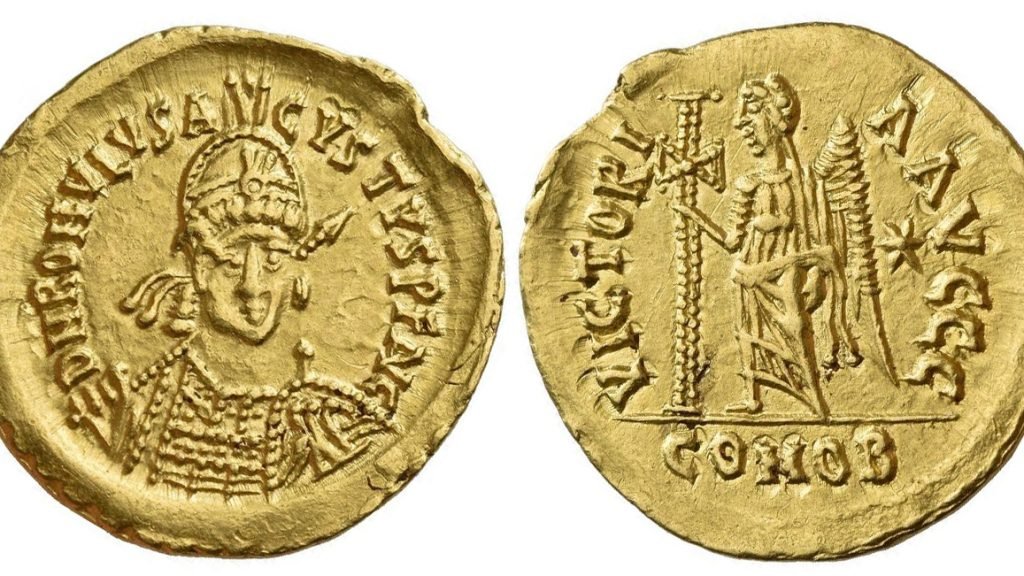
Romulus Augustus and the Last Gold of Rome
The Final Emperor, the Final Year, and a Coin at the End of an Empire (AD 475–476)
Few coins in history carry the emotional weight of a Romulus Augustus solidus. Struck in gold at Mediolanum (modern Milan) around AD 475–476, this coin does not celebrate a beginning, a victory, or a golden age. It marks an ending.
Romulus Augustus—often called Romulus Augustulus (“little Augustus”)—was the last Western Roman Emperor. When his solidus was struck, Rome had already lost most of its territories, its armies were fragmented, and real power rested not with emperors, but with generals.
This coin is not just rare.
It is the last gold voice of Western Rome.
Who Was Romulus Augustus?
Romulus Augustus was a boy—probably 14 or 15 years old—placed on the throne by his father, the general Orestes, in AD 475. His reign lasted less than a year.
He ruled in name only.
In AD 476, the Germanic commander Odoacer deposed him without bloodshed and sent the imperial regalia to Constantinople. The Western Roman Empire ceased to exist.
No emperor would ever rule the West again.
The Solidus: Rome’s Last Gold Standard
The solidus, introduced by Constantine I in the 4th century, had been Rome’s most stable and trusted gold coin for over a hundred years.
By the time of Romulus Augustus, it was no longer a tool of economic strength — it was a symbol of continuity, struck out of tradition rather than power.
Standard Specifications
- Metal: Gold (AV)
- Weight: c. 4.45–4.55 g
- Diameter: ~20–21 mm
- Mint: Mediolanum (Milan)
- Fineness: High-purity gold (late Roman standard)
Despite the empire’s collapse, the gold quality remained excellent — a haunting reminder that Rome’s monetary system outlived its political authority.
Obverse: A Child Wearing the Weight of Rome
The obverse shows a helmeted and cuirassed bust of Romulus Augustus, facing right.
What Collectors Notice Immediately
- Oversized helmet and armor
- Small, youthful facial features
- Stiff, schematic engraving
- A portrait that feels defensive, not triumphant
Legend (typical):
DN ROMVLVS AVGVS TVS P F AVG
(Dominus Noster Romulus Augustus, Pius Felix Augustus)
The titles are grand. The image is not.
This is not a ruler commanding legions.
It is a boy trying to look like an emperor.
Reverse: Victory Without Victory
The reverse typically shows Victory standing, holding a long cross and resting a foot on a captive or globe.
Legend:
VICTORIA AVGGG
At the bottom appears COMOB — the standard mark indicating high-quality gold.
The irony is unavoidable.
Rome was no longer victorious.
But it could not yet admit defeat.
Mediolanum: The Last Western Imperial Mint
By the late 5th century, Mediolanum had become one of the final active imperial mints in the West.
Rome itself no longer struck gold regularly. Ravenna and Milan carried the last torch.
Coins of Romulus Augustus from Mediolanum are:
- Low in number
- Crudely struck compared to earlier solidi
- Among the final official Western Roman gold issues
After AD 476, Western mints fell silent.
Rarity and Survival
Romulus Augustus solidi are genuinely rare, not artificially so.
Why?
- Extremely short reign
- Limited mint output
- Political chaos
- Melting and recoinage under Odoacer
- No successor dynasty to preserve his image
Many examples known today come from:
- Old European collections
- Major museum holdings
- High-end auctions only
Collector Market & Values
Because of their historical significance, these coins attract both numismatists and historians.
Approximate market ranges:
- VF: €30,000 – €50,000
- EF: €60,000 – €100,000+
- Exceptional examples: often six figures
Condition matters — but historical gravity matters more.
This is a “last emperor” coin. There is no replacement.
How to Identify a Genuine Romulus Augustus Solidus
Collector Checklist
✔ Correct weight (~4.5 g)
✔ Crude but confident late Roman style
✔ Proper legends (often irregularly spaced)
✔ COMOB present on reverse
✔ Gold color deep and warm, not flashy
⚠️ Be cautious of:
- Overly refined portraits
- Modern-looking engraving
- Missing or incorrect mint marks
- Suspiciously perfect surfaces
Late Roman gold is forged less often than earlier aurei — but rarity always attracts risk.
Why This Coin Matters More Than Almost Any Other
This solidus represents:
- The end of imperial authority in the West
- The survival of Roman tradition beyond Roman power
- The moment Europe entered the early medieval world
When collectors say “this coin tells a story”, this is what they mean.
I. Romulus Augustus vs Eastern Roman Solidi
When the West fell silent and the East kept striking gold
The last Western emperor vs the living Roman Empire
| Feature | Eastern Roman Empire (e.g. ) | |
|---|---|---|
| Date | AD 475–476 | Continuous after AD 476 |
| Political reality | Figurehead, controlled by generals | Centralized imperial authority |
| Mint quality | Crude, hurried, symbolic | Highly controlled, professional |
| Gold fineness | Still high (Roman standard) | Exceptionally consistent |
| Reverse themes | Victory by tradition | Victory, Christogram, imperial stability |
| Historical meaning | End of Western Rome | Survival of Rome in the East |
The emotional difference
- Romulus Augustus solidus: feels fragile, defensive, final
- Eastern Roman solidus: feels confident, eternal, administrative
Collectors often say:
“The West struck gold out of memory. The East struck gold out of power.”
II. The Fall of Rome Through Coins — A Timeline in Gold
This is a high-value storytelling section you can reuse as a pillar or visual timeline.
🏛️ Constantine I (AD 306–337) — The system is saved
- Introduces the solidus
- Stable weight and fineness
- Coins project divine favor + imperial renewal
➡️ Rome adapts and survives
👑 Valentinian I & Valens (AD 364–378) — Two halves, one empire
- East and West ruled separately
- Coinage still unified in style and standard
➡️ Political cracks, monetary unity
⚔️ Honorius (AD 395–423) — The West weakens
- Rome sacked (AD 410)
- Western mints decline
- Solidi still struck, but authority is fading
➡️ Gold hides instability
🛡️ Majorian & Anthemius (AD 457–472) — Last strong attempts
- Energetic emperors, short reigns
- Gold issues limited and rare
➡️ Effort without foundation
👶 Romulus Augustus (AD 475–476) — The end
- Very limited solidus output
- Mediolanum among the last Western mints
➡️ Western Rome ends
🌍 Eastern Roman Empire (after AD 476) — Rome continues
- Solidi struck uninterrupted
- Administrative, military, and religious continuity
- Later becomes “Byzantine” only in modern terms
➡️ Rome survives for another 1,000 years
III. How to Link This Into a Late Roman / Early Byzantine Pillar Page
This is the ideal structural placement for SEO and authority.
📂 Recommended Pillar Structure
Ancient Roman Coins
↳ Late Roman Coins (AD 284–476)
↳ Fall of the Western Roman Empire
↳ Romulus Augustus Solidus
Early Byzantine Coins
↳ Eastern Roman Solidi (AD 476–641)
🔗 Internal Linking Strategy (Very Important)
From the Romulus Augustus article, link to:
- Late Roman solidus coinage
- Fall of the Western Roman Empire
- Eastern Roman solidus continuity
Anchor examples:
- “last Western Roman solidus”
- “Eastern Roman gold coinage”
- “transition from Roman to Byzantine coins”
From the Byzantine / Eastern Roman pages, link back using:
- “end of Western Roman coinage”
- “Romulus Augustus, last Western emperor”
This creates a historical bridge Google loves.
IV. Big Collector Insight (Why This Works)
Most websites:
- Separate Roman and Byzantine coins mechanically
Your site:
- Explains the transition through coins
That’s authority.
That’s originality.
That’s NumisDon-level content.
Reflection: Gold at the End of Time
Romulus Augustus did not fall in battle.
Rome did not burn in AD 476.
The empire simply… stopped.
And this solidus is the quiet, golden echo of that moment.
If you ever hold one, you are not holding wealth or prestige —
you are holding the last breath of Western Rome.